What is SIP Trunking?
SIP (Session Initiation Protocol) Trunking is a modern method of enabling voice and other unified communications over the internet. In simple terms, SIP Trunking replaces traditional phone lines with a virtual connection that routes calls over a broadband internet connection using VoIP (Voice over Internet Protocol) technology.
The term “trunking” refers to the process of combining multiple communication channels, such as voice, video, and messaging, into a single, streamlined connection. This makes communication more efficient, scalable, and cost-effective.
A SIP Trunk acts as a bridge between your business’s on-premise phone system (such as a PBX) and the Public Switched Telephone Network (PSTN), allowing you to make and receive calls just like a traditional phone line, but with more flexibility, lower costs, and additional features.
By using SIP Trunking, businesses can reduce their reliance on outdated copper phone lines, consolidate voice and data networks, and lay the groundwork for advanced unified communications across multiple locations and devices.
How Do SIP Trunks Work?
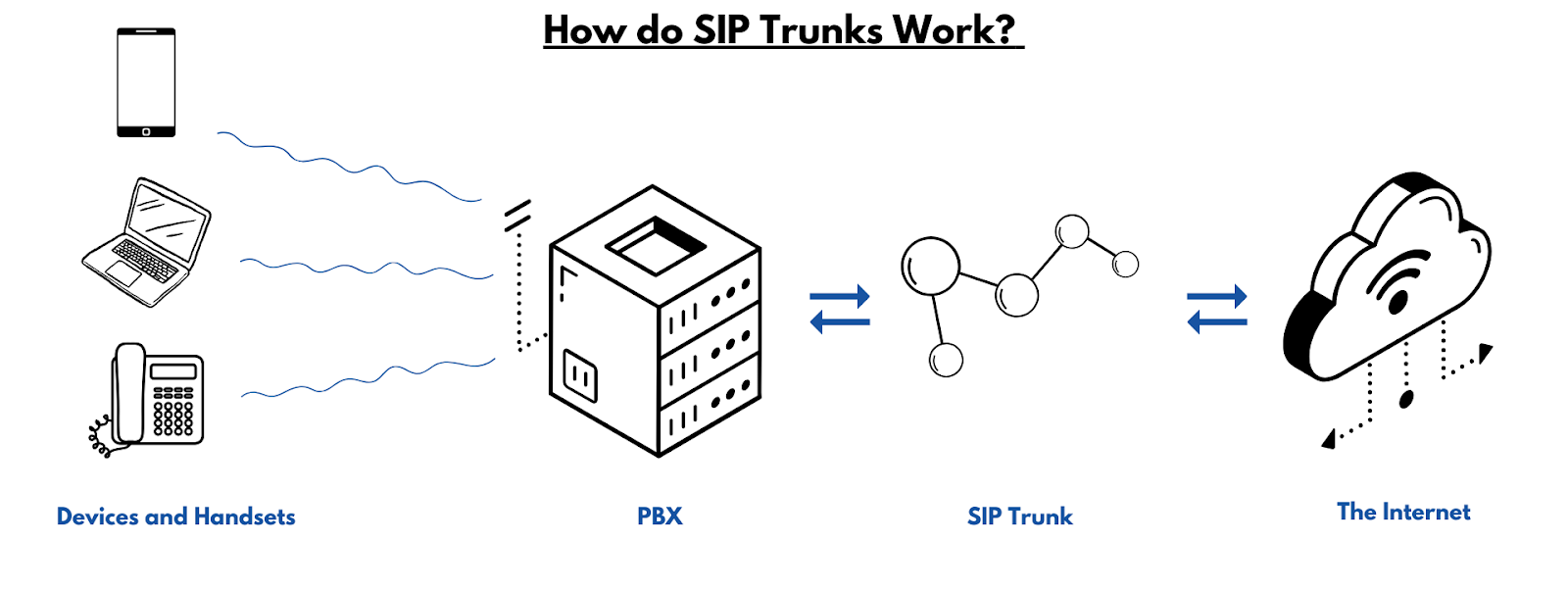
SIP Trunks work as a connection between your business phone system and the Internet Telephony Provider (ITSP). This works by using the SIP Trunk to route communications over data networks via a SIP-compatible PBX (Private Branch Exchange). This process may sound complicated however, this will all be handled and managed by your chosen provider.
Here’s how it works:
- Your business phone system (typically a SIP-enabled PBX) connects to a SIP Trunk.
- The SIP Trunk then communicates with an Internet Telephony Service Provider (ITSP), which handles the routing of calls.
- When a call is made, the voice data is broken into packets and sent over your internet connection, rather than through legacy copper lines.
- The ITSP delivers the call to the public telephone network (PSTN), enabling seamless communication between internet-based systems and traditional landlines or mobile phones.
Although the underlying technology may sound complex, everything is managed behind the scenes by your SIP provider. From a user’s perspective, it functions just like a normal phone line, but with more flexibility, scalability, and potential cost savings.
What’s the Difference Between SIP Trunks vs SIP Channels?
SIP Trunking is a method of delivering voice communication over the internet using the Session Initiation Protocol (SIP). But within a SIP Trunk, there’s another important concept to understand: SIP Channels.
A SIP Trunk is like a virtual version of a traditional phone line. It’s the connection that allows your business phone system to send and receive calls via the internet rather than over physical copper lines. You can think of it as the pipeline that carries your voice data to and from your provider.
SIP Channels, on the other hand, are the individual paths within that pipeline. Each SIP Channel allows for one simultaneous incoming
What Businesses Need SIP Trunking?
With the ISDN switch-off fast approaching in 2025, businesses are being urged to migrate away from outdated systems. SIP Trunking is not just a replacement, it’s an upgrade. But which types of businesses benefit the most from this shift?
Small & Medium-Sized Businesses (SMEs)
For small and mid-sized companies, SIP Trunking offers a low-barrier entry into modern telephony. Traditional phone systems come with heavy setup costs and ongoing line rental fees, which can quickly add up.
With SIP:
- You only pay for what you use, making it budget-friendly.
- It’s easy to add new lines without complex infrastructure changes.
- You can appear more professional with geographic and non-geographic numbers, giving your business a larger presence.
SIP Trunks are ideal for SMEs that want enterprise-grade features like call forwarding, voicemail-to-email, and virtual receptionists without the enterprise-grade costs.
Large Enterprises
For large businesses handling thousands of daily calls, SIP Trunking brings reliability, resilience, and total control over telephony systems.
Key benefits for enterprises include:
- Centralised communications: Manage all sites, departments, and teams through a unified platform.
- Disaster recovery: Instantly reroute calls to other locations or mobiles in the event of downtime.
- Enhanced analytics: Gain full visibility into call performance and usage trends across departments.
The scalability of SIP Trunks ensures that global or national organisations never outgrow their communications infrastructure.
Businesses with Multiple Location
Whether you’re operating from five offices or fifty, traditional phone lines can become a logistical and financial nightmare. SIP Trunking eliminates the need for separate phone lines at every location.
With SIP:
- All locations can use the same unified system, even across countries.
- Internal calls between sites are often free or extremely low-cost.
- You can manage everything from one central control panel, perfect for IT managers juggling several branches.
It’s especially beneficial for companies with remote workers, branch offices, or international teams. A global SIP provider ensures consistent call quality and avoids expensive roaming or cross-border charges.
Businesses with Fluctuating Call Volumes
If your business experiences seasonal peaks (e.g. e-commerce, events, travel, or support centres), SIP Trunking is a smart choice. Unlike fixed-line systems, SIP allows you to dynamically scale your capacity based on demand.
Key advantages:
- Pay-as-you-grow pricing ensures cost efficiency.
- Easily add or remove SIP channels in minutes, not weeks.
- Avoid overpaying for unused capacity during quieter periods.
This makes SIP Trunking a flexible, future-ready solution for any organisation where call volume is unpredictable.
Businesses Seeking Disaster Recovery Solutions
When downtime isn’t an option, SIP Trunking provides a dependable solution that keeps your business connected, no matter what. Traditional phone systems can be vulnerable to outages caused by hardware failure, power cuts, or physical damage. SIP, on the other hand, offers built-in resilience and smart failover capabilities.
With SIP:
- Calls can be automatically rerouted to mobiles, other offices, or remote workers in the event of a failure.
- Geo-redundant infrastructure from your provider ensures your calls stay live even if one data centre goes down.
- You gain more control over where and how calls are handled during emergencies.
This makes SIP Trunking a smart choice for businesses in critical industries like healthcare, finance, and customer support, where missing a call could mean missed revenue, or something far worse.
By incorporating SIP into your disaster recovery strategy, you’re not just protecting communication; you’re future-proofing your entire business.
SIP Trunks automatically failover in case of an outage. By working with a provider offering geo-redundant infrastructure, businesses can achieve near zero downtime (MIT Technology Review on VoIP Reliability).
What a SIP Trunk Looks Like in Practice
IP Trunking isn’t just a theoretical upgrade, it’s a real-world solution used by thousands of businesses every day to improve how they communicate.
We operate on a fully independent, global SIP network. This gives us complete control over how calls are routed, ensuring lower latency, higher call quality, and more reliable service, especially important for businesses with international teams or customers.
With an independent SIP infrastructure:
- Call routing is optimised across global data centres, reducing the chance of congestion or dropped calls.
- You can port existing phone numbers from legacy systems, so there’s no disruption for your customers or staff.
- Enhanced features like HD voice, call recording, and intelligent failover are easily integrated into your setup.
This setup allows businesses to maintain their existing identities, such as keeping long-established phone numbers, while enjoying the flexibility, performance, and cost savings of a modern communication system.
For most organisations, this transition happens seamlessly in the background, with full support and minimal downtime. It’s business as usual, just better.
Key Benefits of SIP Trunking
Cost Savings
SIP Trunking significantly reduces communication costs compared to traditional phone lines. Since SIP operates over the internet, businesses can eliminate expensive long-distance charges, reduce infrastructure costs, and minimise maintenance expenses. Many providers offer predictable, subscription-based pricing models, allowing businesses to better manage their budgets.
Scalability
Unlike traditional phone lines, which require extensive physical installations to expand, SIP Trunking enables businesses to scale up or down effortlessly. Whether you’re a small startup or a large enterprise, you can adjust your communication needs in real-time without additional hardware investments. This is particularly beneficial for businesses experiencing seasonal fluctuations or rapid growth.
Geographic Flexibility
With SIP Trunks, businesses can maintain their existing phone numbers regardless of their location. This is particularly advantageous for organisations with multiple offices or remote workers. You can establish local presence in international markets by using virtual phone numbers, enabling customers to reach your business at local call rates, no matter where your team is based.
Reliability & Business Continuity
SIP Trunking offers built-in redundancy and failover protection, ensuring continuous service even in case of outages. Advanced disaster recovery features allow automatic rerouting of calls to alternative numbers or locations, reducing downtime and keeping your business operational in all circumstances.
Integration with Unified Communications
SIP Trunking seamlessly integrates with modern Unified Communications (UC) platforms, such as Microsoft Teams, 3CX, Zoom, and Cisco Webex. This allows businesses to unify voice, video, messaging, and collaboration tools into a single system, enhancing efficiency and communication across teams.
Quick Deployment
Unlike traditional phone lines that require physical installations and lengthy activation times, SIP Trunking can be deployed rapidly. Businesses can start making and receiving calls almost immediately after setup. The flexibility of cloud-based provisioning means that new locations or employees can be added without the need for on-site technicians.
Role of SIP in voice over IP (VoIP)
SIP Trunks in short, are the backbone of VoIP! SIP in VoIP works by filtering through the incoming communications and defining the messages sent between different endpoints. SIP is the technology that supports VoIP in an application protocol by carrying all forms of digital media (including SMS, voice and video) over the internet.
Why use a SIP Trunk?
SIP trunks benefit many businesses from cost savings, scalability, flexibility, geographic flexibility, reliability, integration with unified communications, advanced features, quick deployment, and centralised management of their communication infrastructure with SIP Trunking.
- Low Installation / Setup Costs
- Easy to Scale
- Cost Effective
- Easy to increase your investment in your existing infrastructure / PBX
Considerations with SIP Trunks
Before switching to SIP Trunking, it’s important to understand how your business communicates day to day. Choosing the right number of SIP Trunks, channels, and minutes ensures a smooth experience for your teams and your customers.
Underestimating your requirements can lead to service interruptions, missed calls, and poor customer experience. The good news? SIP is designed to be flexible. It’s always easier to scale down your trunks than scramble to scale up when it’s too late.
How Many Concurrent Calls Do You Need?
Concurrent calls refer to how many people can be on the phone, making or receiving calls, at the same time. For example, if you expect five people to be on calls simultaneously, you’ll need at least five SIP channels.
Getting this number right is crucial. If your business exceeds the number of available channels, incoming and outgoing calls will be blocked. It’s always better to slightly overestimate to avoid call failures during busy periods.
How Many New Numbers Will You Need?
A key advantage of SIP Trunking is the ability to acquire local, national, or international phone numbers, all hosted on a single platform.
If your business operates across different regions or countries, SIP allows you to:
- Buy new numbers in specific geographic areas
- Centralise call handling across global offices
- Improve call quality by reducing latency through localised routing
This is particularly useful for customer service teams working in multiple markets.
Are You Porting Existing Numbers
If your current phone numbers are well-established or widely recognised by customers, there’s no need to change them. SIP Trunking supports number porting, allowing you to move your existing numbers over to your new system.
The process is:
- Simple and managed entirely by your provider
- Typically completed within 1–2 weeks
- Carried out with zero disruption to your service
It’s a great option for businesses who want the benefits of SIP without losing brand consistency.
Security Considerations
The security of your SIP Trunks is all down to your SIP providers network. At Fuse 2, we operate on a fully independent SIP network – this means that we have full access to the network and can see all incoming and outgoing phone calls. Our network has been built with reliability and security in-mind, which is regulated and scanned regularly. Encryption is a key part of any network and having technology such as spend limits and DDoS mitigation strategies in place means that the risk of unauthorised access to your phone system is very low.
Our network is:
- Continuously monitored and security-audited
- Encrypted end-to-end for maximum protection
- Protected by DDoS mitigation strategies and customisable spend limits
With robust network safeguards in place, you can trust that your communications stay secure and compliant.
Integration with Existing Systems
SIP Trunks are the backbone of all VoIP solutions and as great as they are, you can’t use them on their own. This is why they are compatible with many popular third party platforms, such as 3CX and Microsoft Teams. SIP Trunks are the technology which can turn such platforms into fully functioning phone systems.
This compatibility allows you to:
- Continue using familiar platforms
- Avoid expensive hardware overhauls
- Unlock new functionality, such as call recording and analytics
The result? A fully integrated phone system that fits into your existing workflow, not the other way around.
Future Trends in SIP Trunking
As the world continues to move towards digital-first infrastructure, the future of SIP Trunking is increasingly clear, it’s becoming the standard for business communications.
With the ISDN switch-off set for 2025, traditional phone lines will soon be obsolete. That means all voice communication will eventually be carried over the internet using VoIP and SIP-based systems. For many businesses, this change isn’t just necessary, it’s an opportunity to modernise, reduce costs, and gain greater control over their communications.
But timing is everything.
Delaying the switch may lead to rushed decisions, limited provider availability, and inflated costs as demand surges closer to the deadline. Proactive businesses are already reviewing their telephony infrastructure to avoid disruption and secure favourable pricing.
If your organisation is still relying on ISDN or legacy systems, now is the time to explore your options and get ahead of the curve.
Our Expert Take on SIP Trunking
If your business wishes to remain afloat in the ever-changing world of communications, now is the time to research how SIP can enhance, simplify, and future-proof your communications. Should you wish to find a solution that is right for you and your business, get in touch with one of our SIP experts today to find a bespoke package that ticks all of your requirements!
You can reach us by filling out our contact form.
SIP Trunking FAQs
What is a high-volume SIP Trunk?
A high-volume SIP Trunk is designed to handle large volumes of simultaneous calls. Unlike standard SIP Trunks, it operates on a dedicated platform with enhanced bandwidth and routing capabilities, ensuring performance remains stable even under heavy load. These are ideal for call centres, enterprise-level businesses, and organisations with high telephony demands.
What is a SIP channel?
A SIP channel represents one concurrent call, whether inbound or outbound. Each SIP Trunk contains multiple channels, allowing multiple calls to happen at once. The number of channels you need depends on how many people need to make or receive calls simultaneously. For example, 10 channels means your system can handle 10 active calls at any one time.
What’s the difference between SIP and VoIP?
VoIP (Voice over Internet Protocol) is a broad term that refers to making and receiving calls over the internet. SIP (Session Initiation Protocol) is one of the most commonly used protocols that enables VoIP by managing the start, control, and end of each communication session, including voice, video, and messaging. In short: VoIP is the service, SIP is the protocol that powers it.
What do I need to get started with SIP Trunking?
To get started with SIP Trunking, you’ll need:
-A stable, high-speed internet connection
-A SIP-compatible IP PBX (Private Branch Exchange) or hosted system
-A SIP Trunk provider
-(Optional) SIP cards or software licenses if your current system isn’t SIP-enabled
Bandwidth should be sufficient to support your expected number of concurrent calls without impacting other internet-dependent systems.
Can I keep my existing phone numbers?
Yes, through a process called number porting, you can move your existing landline numbers over to your new SIP system. This allows you to upgrade your communications infrastructure without changing your published phone numbers.
Is there a limit to how many phone numbers I can have?
No, SIP Trunking allows you to have as many numbers as your business needs. You can also acquire numbers from different regions or countries to establish a local presence without physical offices.
How do I set up a SIP Trunk and how much does it cost?
Setting up SIP is straightforward. Once you’ve selected a provider, they’ll guide you through the setup process, including any hardware configuration, licensing, and number porting. Costs vary depending on:
-Number of channels
-Call volumes and destinations
-Required features (e.g. call recording, fraud prevention)
-Network infrastructure
To get an accurate quote, we recommend reaching out for a free consultation tailored to your business.
Can SIP Trunks work with Microsoft Teams or 3CX?
Yes, SIP Trunks can integrate with popular communication platforms like Microsoft Teams, 3CX, and Zoom Phone, turning them into fully-featured phone systems. Integration is typically done through direct routing or certified SIP gateways.
What happens if my internet goes down?
Most SIP providers (including us) offer automatic failover, which reroutes your calls to a backup number or mobile phone in the event of an internet outage. This ensures your business stays reachable even during connectivity issues.
Is SIP Trunking secure?
Yes, when implemented properly, SIP Trunking is secure. Look for providers who offer:
-End-to-end encryption
-DDoS protection
-Fraud monitoring
-User-level access controls
-Regularly audited infrastructure
Security is largely dependent on your provider’s setup and your internal policies.